ServicesUnder-sink reverse osmosis
Under-Sink Reverse Osmosis in Balch Springs
An under-sink reverse osmosis system puts a dedicated tap at your kitchen sink for drinking water, morning coffee and the pasta pot. Before recommending one, we test your water and look inside the cabinet, then tell you plainly whether it makes sense and which model suits your home.
What a reverse osmosis system does, and when it fits
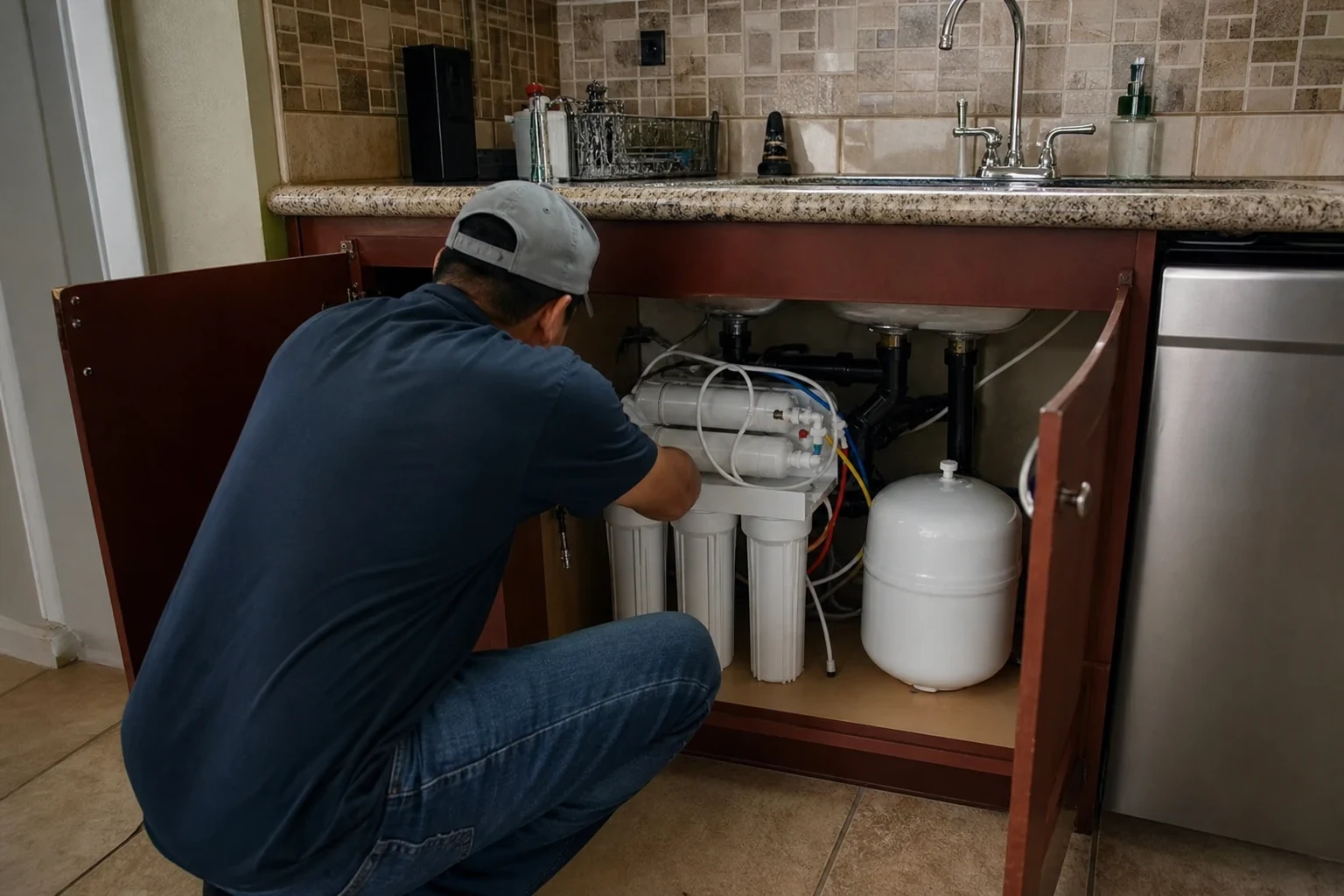
Inside the unit, your household water pressure presses water against a semipermeable membrane whose pores are far smaller than a dissolved mineral or metal ion. Clean water makes it through. Dissolved solids, most metals and many trace contaminants stay behind and are carried off to the drain. A carbon stage ahead of the membrane strips out chlorine, which would otherwise wear the membrane down, and a second carbon filter at the end gives the water a final polish. The whole assembly sits in the cabinet under your kitchen sink and feeds a small faucet of its own.
Reverse osmosis earns its place when the focus is the glass on your table and the pot on your stove: a chlorine taste you can't get past, worry about lead from older pipes and fixtures, or simply wanting more certainty than the tap gives you. It is not a whole-house treatment. If the taste or odor bothers you in the shower too, whole-house carbon filtration may be the better place to start, and we will say so.
What the installation includes
Water test and pressure reading
We measure total dissolved solids, check for chlorine and read your incoming water pressure. A membrane needs steady pressure to work well, so this number shapes the recommendation.
Staged filter assembly
A sediment prefilter, carbon prefilter, membrane and carbon polishing filter, mounted neatly to the cabinet wall so the housings are easy to reach later.
Dedicated faucet, set with care
We place the faucet in an existing sink hole when there is one. Where no spare opening exists, we bore one using tooling matched to granite, quartz or laminate, and cover the surrounding surface while we work.
Drain and supply connections
The system ties into your cold supply line and the sink drain with a proper drain saddle, set so it works cleanly alongside a garbage disposal.
Optional refrigerator line
If you want filtered water at the fridge dispenser and ice maker, we can run a line there when the route allows.
Cleanup and walkthrough
We leave the cabinet tidy, show you how to change each filter and write down which cartridges your system uses.
Signs a reverse osmosis system is worth considering
You buy bottled water out of habit
If the tap tastes off enough that you keep cases of bottled water around, a dedicated faucet usually replaces them.
Chlorine taste in coffee and tea
Treated city water carries a disinfectant, and some people notice it most in hot drinks. The carbon stages handle this well.
Older plumbing or fixtures
Aging faucets, solder joints and service lines can leach lead into water that left the treatment plant in good shape. A test tells us whether that is happening in your home.
White crust on kettles and glassware
Mineral spotting points to dissolved solids. We confirm the level before suggesting anything, because a softener and reverse osmosis solve different problems.
A test result you want to act on
If water testing turned up something at the tap, reverse osmosis is often the most direct fix for drinking water.
How the work runs
- 1
Inspection and testing
We test your water at the kitchen tap, read the pressure and look at the cabinet space, the drain, the shutoff valves and the countertop.
- 2
Plain findings
We explain what the numbers mean and whether reverse osmosis is the right answer. If it isn't, we tell you that and what would help instead.
- 3
Installation day
We shut off the cold supply, mount the system, set the faucet and make the drain and supply connections. Most of the work happens inside the cabinet, so the rest of your kitchen stays usable.
- 4
Flush and verify
We flush the new filters, check every fitting for leaks and test the finished water so you can see the difference in dissolved solids next to the tap reading.
What changes the price
You get every estimate in writing with each item listed, so the cost of each piece of the job is clear before any work begins. Most of the price comes from the system you pick and the conditions under your sink. These make the largest difference.
- Kind of system
- Systems with a tank, tankless models and units that add a remineralizing stage are each built and priced their own way. We pick one based on how much water your household drinks.
- Your countertop
- An existing hole is the easiest option. Boring through stone or quartz takes longer and calls for the proper tools.
- Incoming pressure
- With low pressure, the membrane may need a booster pump to make water efficiently.
- Line to the fridge and ice maker
- Running tubing to a dispenser or ice maker adds material and labor. The amount depends on how far the line travels and the route it takes through cabinets or walls.
- State of the plumbing under the sink
- Tired shutoff valves or a corroded piece of drain are best swapped out while we're installing. We point out what we find and get your okay before adding anything.
Questions about reverse osmosis
Something not covered here? (972) 787-1656
How much water goes down the drain with reverse osmosis?
Some, by design. While it filters, the membrane sends a steady trickle to the drain that carries off the minerals it has rejected, which keeps its surface from clogging. Current designs send far less down the drain than units from years past, and healthy water pressure tilts the balance further. We give you the actual ratio for the system we suggest.
Will it remove the minerals from my water?
It removes most dissolved minerals along with the contaminants. Many people like the clean taste. If you prefer a little mineral content back, we can add a remineralizing stage after the membrane.
How often do the filters need changing?
The prefilters and polishing filter typically want fresh cartridges once or twice a year, while the membrane lasts considerably longer. Your water and how much you draw from the faucet set the real schedule. Our filter replacement and maintenance service can keep track of this for you.
Will it fit under my sink with a garbage disposal?
Usually, yes. Tank systems need more room than tankless ones, which is one reason we look at the cabinet before recommending a model.
Will this treat the water in my showers too?
No. Reverse osmosis serves one faucet and, if you like, the refrigerator. For water throughout your home, whole-house carbon filtration or iron and sediment filtration is the right tool, depending on what the test shows.
See what's in your tap water first
We will test your water, look at your sink and give you a clear answer on whether reverse osmosis is worth it. Serving Balch Springs, Mesquite, Seagoville and nearby.